🌳 Our Reforestation Project
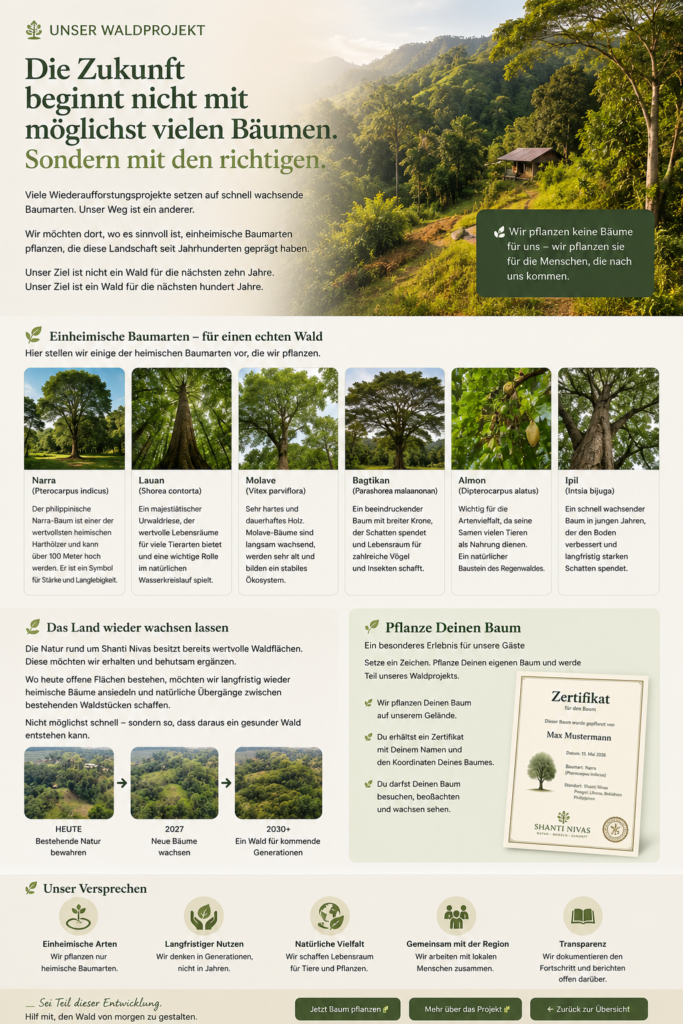
The Future Doesn’t Begin with Planting as Many Trees as Possible.
It begins with planting the right ones.
Many reforestation projects focus on fast-growing tree species.
Our approach is different.
Wherever it makes ecological sense, we want to plant native tree species that have shaped this landscape for centuries.
Our goal is not a forest for the next ten years.
Our goal is a forest for the next hundred years.
Why Native Heritage Trees?
An old tree is far more than wood and leaves.
It provides shade.
It stores water.
It protects the soil.
It provides a habitat for birds, insects, and countless other forms of life.
And it connects generations.
Some of the trees we plant today will never reach their full size within our own lifetime.
That is exactly why it is worth starting today.
Helping the Land Grow Again
The landscape surrounding Shanti Nivas already includes valuable areas of natural forest.
Our aim is to protect them and carefully expand them.
Where open land exists today, we hope to gradually reintroduce native trees and create natural connections between existing forest areas.
Not as quickly as possible.
But in a way that allows a healthy forest to grow for generations to come.
We are not planting trees for ourselves.
We are planting them for the generations that follow.
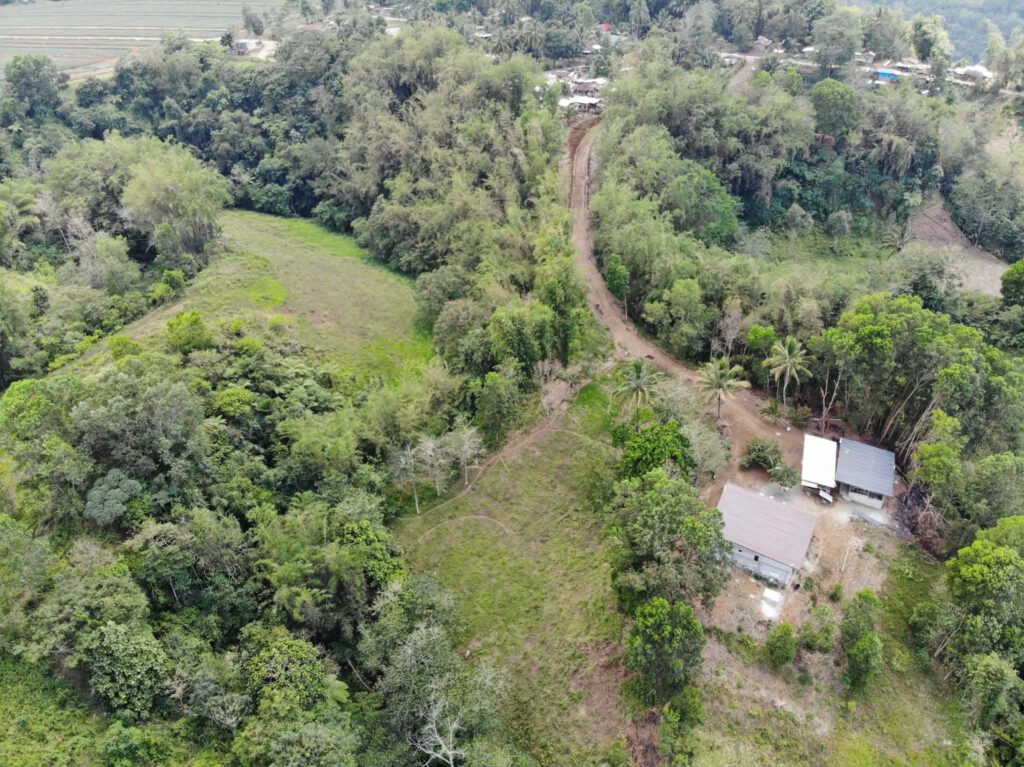
Over the coming years, we hope to plant native tree species and carefully expand the existing forest areas.
🌳 Narra
(Pterocarpus indicus)
Narra is the national tree of the Philippines and symbolizes strength, resilience, and the country’s natural beauty. It is one of the most valuable native tree species and can live for several centuries. Its golden-yellow blossoms provide an important food source for many insects.
Growth: Moderate
Mature Height: Up to 35 metres
Lifespan: 200–300 years
Special Feature: National tree of the Philippines
Its Role in the Forest:
- 🌿 Improves soil quality
- 🐝 An important food source for insects
- 🌳 Long-lasting provider of shade
“A symbol of strength and hope.”
🌳 Lauan
(Shorea contorta)
Lauan is one of the true giants of the Philippine rainforest. This remarkable tree has shaped the country’s ancient forests for centuries and can grow to more than 50 metres in height. Its towering canopy provides a habitat for countless species of birds, insects, and plants.
Growth: Moderate to fast
Mature Height: Up to 55 metres
Lifespan: More than 300 years
Special Feature: A characteristic tree of the original rainforest
Its Role in the Forest:
- 🦜 Habitat for countless wildlife species
- 🌧️ Supports the natural water cycle
- 🌎 Stores large amounts of CO₂
“A future giant of the rainforest.”
🌳 Molave
(Vitex parviflora)
Molave is renowned for its exceptional strength and durability. Although it grows more slowly than many other tree species, it becomes an enduring part of a healthy forest and can thrive for centuries.
Growth: Slow
Mature Height: Up to 30 metres
Lifespan: Several centuries
Special Feature: One of the hardest native hardwoods
Its Role in the Forest:
- 🌱 Strengthens the forest ecosystem
- 🌳 Exceptionally long-lived
- 🌿 Contributes to biodiversity
“Slowly grown – created for generations.”
🌳 Bagtikan
(Parashorea malaanonan)
Bagtikan is among the tallest tree species of the Philippine rainforest. Its broad canopy provides generous shade and creates ideal conditions for young trees as well as countless species of birds and insects.
Growth: Moderate
Mature Height: Up to 60 metres
Lifespan: More than 300 years
Special Feature: Excellent carbon storage capacity
Its Role in the Forest:
- 🐦 Important wildlife habitat
- 🌳 Forms the upper rainforest canopy
- 🌎 Captures large amounts of CO₂
“The roof of the rainforest.”
🌳 Almon
(Dipterocarpus alatus)
Almon belongs to the Dipterocarpaceae family and is an important part of Southeast Asia’s tropical rainforests. Its seeds provide food for many wildlife species and help support the forest’s natural regeneration.
Growth: Moderate
Mature Height: Up to 50 metres
Lifespan: More than 250 years
Special Feature: An important food source for wildlife
Its Role in the Forest:
- 🐿️ Provides food for many animal species
- 🌿 Supports the forest’s natural development
- 🌧️ Helps regulate the natural water cycle
“An essential building block of a healthy rainforest.”
🌳 Ipil
(Intsia bijuga)
Ipil is one of the Philippines’ most beautiful native hardwoods. Young trees grow relatively quickly and begin improving the local microclimate at an early stage. Over the decades, Ipil develops into an impressive shade tree.
Growth: Fast when young
Mature Height: Up to 45 metres
Lifespan: Several centuries
Special Feature: A rare and highly valued hardwood
Its Role in the Forest:
- 🌱 Improves soil quality
- 🌳 Provides shade early in its growth
- 🦜 Creates habitat for wildlife
“A tree that will outlive generations.”
🌿 Our Journey Has Only Just Begun.
We don’t know what this forest will look like in twenty or fifty years.
But we do know that every generation can decide what legacy it wants to leave for the next.
With every native tree we plant, we move one step closer to that vision.